0800 0146 146
Logo
Contact Us View Our Courses
Courses

PMVA General Services Association (GSA) Accredited Training

This is a three day accredited and certificated course for staff that work in care and mental health environments:
  • Day 1 – Introduction to PMVA, Legislation and ethical issues, Disengagement and breakaway techniques
  • Day 2 – Communication including verbal and non-verbal, Identification of triggers and the assault cycle, Low level restraint techniques
  • Day 3 – Turning the patient, supine and prone restraints, Importance of reviews, reflection and adequate change management, Theory and practical assessment
Contact Us

PMVA – General Services Association (GSA) accredited course

Who’s it aimed at?

This certificate is designed to provide training for staff that work in care and mental health environments who may need to disengage or restrain service users, for example, those who are self-harming, and need to be effectively restrained under duty of care.

No previous PMVA training is required to take part on this course.

Entry requirements

This course is suitable for learners aged 18 and above. As detailed above, no previous PMVA training is required to take part on this course.

Course Outcomes

Upon completing the course, learners will be able to:

  • Define PMVA
  • Understand the Mental Health Act and the Mental Capacity Act
  • Understand the law around the use of force
  • Have an understanding of government guidance in this area
  • Disengage from hair-pulling, grabs and strangles
  • Prompt and guide service users
  • Know when and how to use non-restrictive interventions
  • Know when and how to use restrictive interventions
  • Complete post-incident reviews and influence change
image10
Course duration

Half Day – 3.5 Hours

Full Day – 7 Hours

Clock Icon
Course learners

16 Per Course

Group Icon

Course Objectives

Prevention Management Violence Aggression

The training cover:

  • The law in relation to the use of physical force to defend themselves and others
  • Demonstrating appropriate and effective physical skill for breakaway skills, breaking away and defending against a violent assault
  • Distance and stance
  • Wrist grabs
  • Defences against punches, slaps, strangles and hair grabs
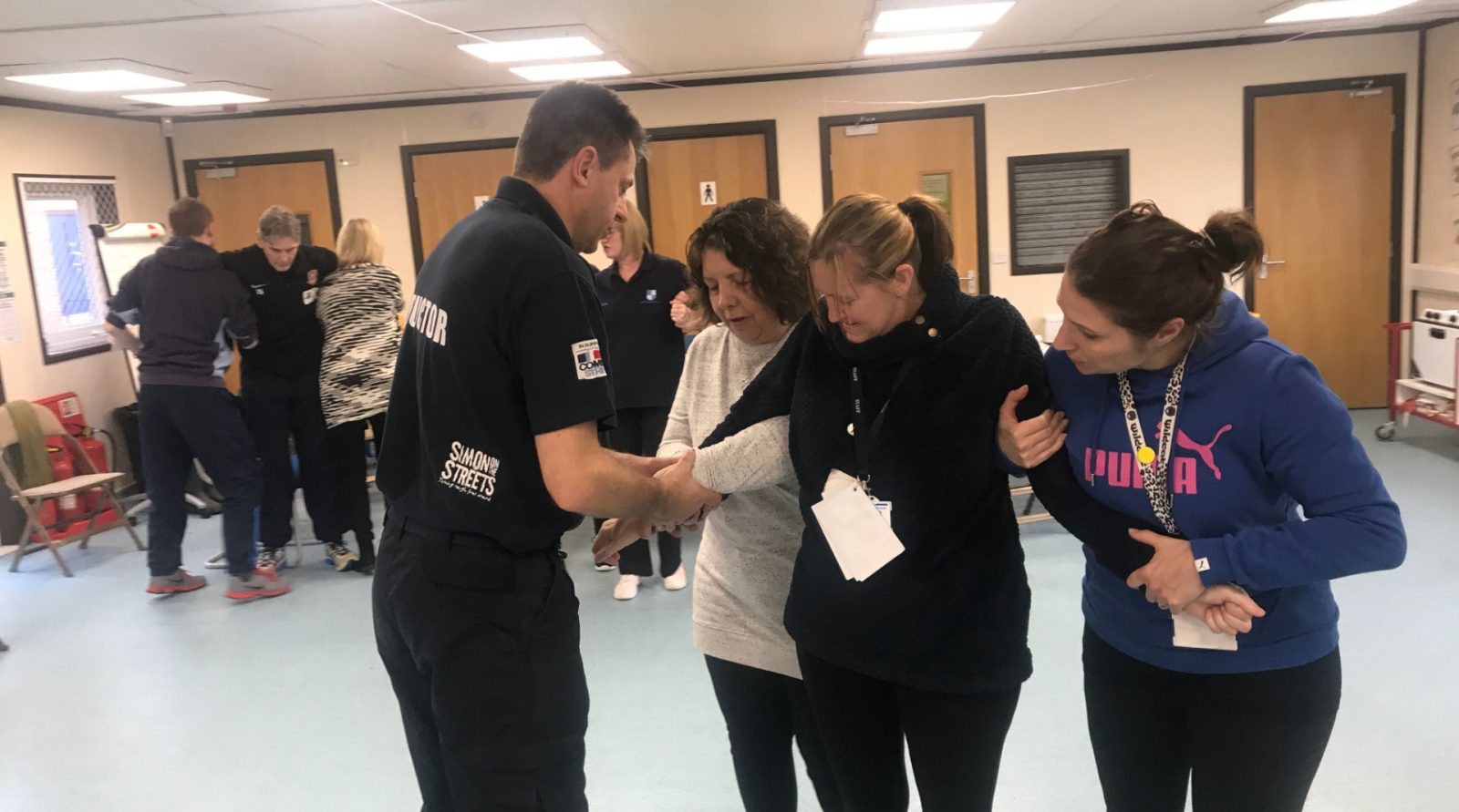
  • A method of physically prompting and guiding a person
  • The use of a non-restrictive standing hold that can be used as an escort
Conflict Management
  • Non-restrictive methods to manage behaviour in seated positions and on the floor
  • A two-person restrictive standing hold that can be used as an escort
  • A two-person restrictive seated hold
  • A team method to separate people fighting
  • How to support a person to and from the floor
  • How to restrict a person’s movement when in a horizontal position
  • How to move a person held horizontally to a safer position
  • An explanation of why some techniques should not be used